Site Meter
Showing posts with label Language. Show all posts

30 July 2012

Good Deeds, Righteousness, or Alms?

A few days ago I talked about the differences in a few English Bible translations. Not the standard kind of "thee" versus "you" differences, and not the bigger, deep theological sorts of differences. Something in between, really. This post will follow up where I left off and is a little longer than usual.

In Matthew 6:1, Jesus says that we shouldn't be making a showy spectacle of ourselves as we do good stuff. We should not help people so that we'll get attention and credit for doing something good. (At the same time, we should be an example to people around us; our motivation is the key.)

In that verse the New Living Translation quotes Jesus as saying, "Don't do your good deeds publicly, to be admired by others..." The phrase "good deeds" is also used in Matthew 5:16: "Let your good deeds shine out for all to see..."

I thought it odd that Jesus would speak of exactly the same acts twice within five minutes of each other, once saying to do them publicly and next saying to do them privately, so I looked at the English Standard Version for a different perspective. Sure enough, while in 5:16 the ESV says "let your light shine before others, so that they may see your good works," it says in 6:1 "beware of practicing your righteousness before other people..." Must be a different Greek word(s) in the two verses, I reasoned. This proved to be correct.

In my Blue Letter Bible app for iPhone (which I tend to use more than YouVersion because it has a Greek interlinear feature), looking at the Greek text, "good works" (καλός ἔργον - kalos ergon) mentioned in 5:16 are specific works. "Kalos" means beautiful or good, and "ergon" means to work, toil, or labor. "Righteousness" (δικαιοσύνη - dikaiosunē) in 6:1 focuses more along the lines of a person's good character (equity of character or action), meaning to me that the latter was saying, "Don't try to get people to think that you're all pious and stuff. Be humble."

Good enough to give clarity the two passages. And then I looked at the King James Version.

"Take heed that ye do not your alms before men, to be seen of them..." Zoiks! That's different. I saw no way of rendering "dikaiosunē" to mean alms or money, so I checked another interlinear Bible at Scripture4All.org. Imagine my surprise when I noted that Matthew 6:1 used the Greek word "ἐλεημοσύνη" -- eleēmosunē. This means "compassionateness" (is that even a word?) or alms, as exercised toward the poor. This made Jesus' words in 6:1 have a much more focused point. He was literally talking about giving to the poor; a specific kind of work that we shouldn't trumpet so people will see us being all philanthropic and what-not.

But why the differences in the Greek text? It's easy to understand the variances in English translations, but could be a big deal if someone's using a different Greek manuscript.

Ever notice the footnotes in your Bible that say things like, "Some manuscripts add Bless those who curse you. Do good to those who hate you."? I'll bet you have. Have you seen the footnote at Mark 16:8? "The most reliable early manuscripts of the Gospel of Mark end at verse 8. The majority of manuscripts include the 'longer ending' immediately after verse 8."

Here's the tip of the iceberg: the King James Version was translated from a manuscript called Textus Receptus, meaning "the received text." Almost all modern translations rely primarily on other manuscripts, notably Codex Vaticanus and Codex Sinaiticus (interestingly, Sinaiticus was discovered in St. Catherine’s Monastery at Mount Sinai in 1844, supposedly in a wastebasket about to be burned to help heat the monestary). The latter two, dating to about the 4th century A.D., are older than the most recent copies of Textus Receptus by a few hundred years, so one line of reasoning says these must, then, be more accurate manuscripts. But not so fast! You'll find that many phrases from Textus Receptus that are omitted in Vaticanus and Sinaiticus are quoted by sources within 50 years of Jesus' resurrection.

Here we have the source of a debate that has remained strong (heck, it's raged) for several hundred years now, though it is much less visible than many other debates in the Church.

My point is not to fan the flames of that debate. I'm not saying that the KJV, translated in 1611, is superior to modern translations. I'm not even arguing for one ancient manuscript over another. What I'm saying is that we live in a fantastically wonderful time in history. Do you realize the breadth of ancient study materials available to the average person? How on earth could we squander these things? If we truly believe that we have in our possession a divine book that the Creator of the universe wrote/breathed so that we can know Him and know more about Him, why in the universe do we leave it sitting on the table, on a shelf, in a car floorboard, or in a drawer?

Why don't we take advantage of the amazing resources at our fingertips? Here are just a handful of online tools that you need to be taking advantage of:

  • The Blue Letter Bible -- Great site. The mobile app is only for iPad, iPod, and iPhone.
  • E-Sword -- A program rather than an online tool, and an absolute must-download. Not available in a mobile version.
  • BibleGateway.com -- What Chick-Fil-A is to southern Baptist churches, BibleGateway is to Christian internet users.
  • Online Interlinear Hebrew Old Testament -- Awesome but not optimized for mobile devices. Search results are in PDF files.
  • Online Interlinear Greek New Testament -- Again, awesome but not optimized for mobile devices. Search results are in PDF files.
  • BibleStudyTools.com -- This site comes highly recommended by many friends, but I haven't gotten too much mileage out of it. Looks good but a little cluttered.
  • Interlinear Bible -- Guess what this is.

    Here are some links that will help you research the differences between the various ancient manuscript sources for the Bible. You'll find that the debate can be quite heated. Most who embrace the KJV-only view have no room to tolerate anyone who disagrees. In their defense, this is the Word of God that we are discussing; not Beowulf.

  • GotQuestions.org -- What are Codex Sinaiticus and Codex Vaticanus?
  • Textus Receptus
  • Codex Sinaiticus
  • Codex Vaticanus
  • NLT Frequently Asked Questions
  • KJV Today
  • Codex Sinaiticus: It Is Old But Is It The Best?
  • 22 July 2012

    Good Deeds and Contradictions

    When reading or studying the Bible there is danger in grabbing a verse here and a verse there to support a desired conclusion. There's also danger in getting one's primary (or only) dose of Scripture and teaching via topical sermons delivered by an eloquent speaker (or worse, a bad one). When we're challenged or confronted with an argument about contradiction in Scripture, we can be taken completely off-guard.

    One of the worst responses in this kind of situation is simply to say, "I just take the Bible on faith," and dismiss the challenge as being made by an ignorant Christian-hater. The fact is, most of the time it's not the Bible we're taking on faith. Often it's the teaching of someone who pieced together some verses to bolster a themed speech. One of the most familiar examples of this is Jesus' statement, "For where two or three have gathered together in My name, I am there in their midst." Jesus was not talking about Church services. He was addressing confrontation of sin among believers.

    This morning my Scripture reading included Matthew 5 and 6. In those chapters there are two quotes spoken by Jesus in a single sitting -- the Sermon on the Mount. They're interesting when considered together (emphases mine):
    "No one lights a lamp and then puts it under a basket. Instead, a lamp is placed on a stand, where it gives light to everyone in the house. In the same way, let your good deeds shine out for all to see, so that everyone will praise your heavenly Father." (Matthew 5:15-16, NLT)
    “Watch out! Don’t do your good deeds publicly, to be admired by others, for you will lose the reward from your Father in heaven. When you give to someone in need, don’t do as the hypocrites do—blowing trumpets in the synagogues and streets to call attention to their acts of charity! I tell you the truth, they have received all the reward they will ever get. But when you give to someone in need, don’t let your left hand know what your right hand is doing. Give your gifts in private, and your Father, who sees everything, will reward you." (Matthew 6:1-4, NLT)
    Following up on these passages, I read what I consider to be some rather poor commentaries trying to justify what seems to be a set of contradictory statements. One, for instance, took a few other verses and attempted to say that Jesus was not talking about works in 5:15-16 (you know, where He says "works"), but about His words. Voilà! No contradiction! I would be embarrassed to deliver that as a rebuttal to someone claiming the passages are contradictory.

    There are several ways to explain the seeming contradiction, and some are fairly solid.

    One way is to note that Jesus added the critical phrase "to be admired by others" in Matthew 6:1. This shows that our motivation is at least as important as the resulting deeds, if not more important.

    Another explanation comes by looking at the Greek text and noting that in Matthew 5:16 Jesus said "good deeds" (καλὰ ἔργα) but in 6:1 He actually said "righteousness" (δικαιοσύνην). (The NLT unfortunately renders both as "good deeds," so this line of thinking is less obvious.) At this point we could draw a distinction between "good deeds" as something good to seen by others and "righteousness" as something we shouldn't try to show off in an arrogant and pious way.

    But most wouldn't get as far as that last explanation, because Greek and Hebrew are thought of as the sole domain of scholars, teachers, and pastors, but not the ordinary layperson. However, given the absolutely amazing tools at our disposal in the modern world we can peer back into the original languages and study some specifics. A word of warning, though: it is very important to realize that, among other things, the average person is not a cultural expert on the ancient middle east, and therefore some points will simply not be clear without drawing on the knowledge and wisdom of others who have studied for years. However, we can find answers to many questions this way more often than not.

    Considering that, going a little further into Matthew 5:15-16 and 6:1-4, I noted that the King James Version doesn't use "good deeds" or "righteousness" in 6:1. Rather, the KJV says "do not your alms before men," making this verse a statement about giving money. Now, that is decidedly different from -- and more specific than -- the other readings. It also happens to wrap up nicely with Jesus talking about giving to the poor in 6:4.

    If you've read this far, I applaud you. I honestly might be bored by now if I were you. Are you interested in knowing the reason for the difference between the reading in the KJV and the NLT (and ESV, NASB, and most other translations)? If not, I shall move on to another topic next time.

    17 April 2011

    The Office - Post-Script

    When I was very young, my cousin (who was also very young) sent me a birthday card that began, "Dear DeAn." He was apparently learning his capital letters.

    That one letter's capitalization made a bit of a difference in things. What we do with our letters, and our language, impacts our understanding and observation.

    I think my friend Leroy summed things up well in our lengthy offline discussion about the office/position of "pastor" in the Church. He said something to the effect of "We tend to think of 'pastor' as a noun rather than a verb." I believe that begins to get at some of the issues behind my last post.

    We've done similar things with the words "church" and "witness," and have redefined "Christian" over the ages. It's time to put Biblical definitions back with these words.

    31 October 2010

    "Go To Church" - Really?

    If this looks familiar, you're not nuts. This post was originally written a little over a year ago.

    I've tried several times to adequately put into words why I believe that our misuse of the word "church" is not only evidence of incorrect thinking, but it severely undermines our understanding of who we are and who we're called to be. The problem is, I tend to come off as someone who's splitting hairs.

    So I'll try this once more. Your responses and reactions are welcomed.

    Which one of us would say, "Thank goodness it's Friday! I'm looking forward to going to 'family' and crashing in the recliner." Of course, you might say, "It's family night," but in doing so you wouldn't be thinking of your family as an activity. You'd be describing and thinking of a group of people.

    Splitting hairs? Isn't it at least a little bit odd that out of 118 uses of the Greek word "ekklesia" (which is translated "church") in the New Testament, not a single usage refers to an activity? Each refers to a collective group of believers. (note: some manuscripts claim 111 uses, and in three cases it may be tenuously argued that the word means something vaguely like a verb)
    As we've done with the word "witness," with incredible effectiveness, we've confined "church" to an event that occurs in a designated, finite time and space. We no longer think of "church" as a family of believers. Instead we think of it as an event or activity in which we have the option to participate or not. Further, we're encouraged to bring as many non-believers as possible to these events so that they can listen to the pastor and get saved.

    At the very least, here's what we've done in the above paragraph:
    • Removed the bond of family from the body of believers. "Church" is not a unit now; it is an event.
    • Acknowledged that our off-hours (if we consider Sunday morning only) -- the other 166 hours of the week, literally 98.9% -- do not include "church"
    • Assigned our command from Jesus Christ -- to be witnesses -- to be handled by a professional Christian
    • Reassigned ourselves from the task of going and making disciples to inviting people to sit with us and hoping that they become disciples
    Whether or not we'd like to admit it, these lines of thought come directly from the understanding we now have of "church". Our incorrect use of this word simply and accurately represents how we view ourselves. How pervasive is this thinking? Do a Google image search for the word and you'll see what it means not only to believers, but to the rest of the world.

    If we've given this word a new meaning, how then do we refer to the actual ekklesia? (I'd venture to say that we don't refer to it very often.)

    As a side note, piggy-backing onto my post about teens giving up on Christianity, if this is all that they think church is, is it really all that surprising that teens find nothing life-changing about it, or even that they might find the whole thing boring?

    19 February 2010

    deep thoughts on overheard conversations

    Let me be very clear: I don't like using the word "butt" to refer to part of the anatomy. Although it's not number one (or maybe even in the top 100) in the list of "bad" slang words -- and yes, it's still considered to be slang -- it's not a favorite. With that qualification, I'm going to use it anyway as a part of a fancy new "deep thought" saying that I think I've just invented.

    Here it is, for your contemplation:
    Always let your conversation be conducted in such a way that your mom (or other person that you greatly respect) would not be offended if you accidentally butt-dialed her and she overheard everything you said.
    I believe this might be a culturally-adjusted version of Colossians 4:6, "Let your speech always be with grace, as though seasoned with salt, so that you will know how you should respond to each person." (NASB)

    My apologies to those of you who are offended. Please don't be that way. I would say this in front of my mom. 

    26 December 2009

    in which i obsess over educational blunders

    When our kids were very small, Winnie the Pooh videos were the ones we primarily chose for entertainment for them rather than going with Barney videos (I still think there's something evil in those things), etc.

    One of the series of videos was designated "Learning," and it was a series that taught, in very broad ways, some basic concepts like sharing or helping others -- things that children could use throughout life. (Another series was called "Playtime," and I suppose it was more of a "Pooh on the torpedoes! We're going to have fun and not worry about this 'learning' stuff!" series.) Videos weren't a source of educational material for us, but if our kids picked up good stuff while watching a fun video, hooray.

    It always struck me as ironic that at the beginning of each "Learning" VHS tape (yes, they used to have these things called "VHS tapes") there was a promo for other Pooh videos, and it started out with the narration saying, "Hey, kids! Now there's three new exciting videos..." In other words, the voice said, "Hey, kids! Now there is three new exciting videos..."

    That probably won't make many of you flinch, and I know these weren't grammar videos, but in any childhood "learning" media, I'm of the opinion that there shouldn't be obvious educational blunders. To me, saying "there is three videos" is sort of like saying, "I should of gone to the store," or, "Can I go to the bathroom?" or something like that. In a broad context, the videos were promoting the idea of learning, and while they taught many things well, like the fact that it's always good to help others, they helped to establish an incorrect foundation in other areas.

    Real-life tie-in: in our churches we often teach excellent Biblical truths, like "love God, love others, help others at your own expense for the sake of Christ," etc. However, at the same time we're doing this, we build on wrong foundations elsewhere.

    I think, for instance, of the correct teaching that we are to live a life of obedience to God because we love Him, which is a holy, beautiful, and accurate principle. However, by implication and frequently in practice, we can teach people the opposite by communicating that if they attend all scheduled services, get involved in church activities, and tithe, they are automatically reaching the world for the sake of Christ.

    Can you think of some ways in which we might teach the truth in one area but are simultaneously undercutting it in another? And just how obsessive do you think I'm being about the Pooh video?

    22 December 2009

    if yuo cna raed tihs

    My daughter sent me an e-mail today that was pretty cool. I've seen a lot of forwarded e-mails, but hadn't seen this one. It's well off the beaten path of typical EGBDF fare. For no reason other than curiosity, I'm interested in knowing how easy this is for you to read:

    i cdnuolt blveiee taht I cluod aulaclty uesdnatnrd waht I was rdanieg. The phaonmneal pweor of the hmuan mnid... aoccdrnig to a rscheearch at Cmabrigde Uinervtisy, it dseno't mtaetr in waht oerdr the ltteres in a wrod are, the olny iproamtnt tihng is taht the frsit and lsat ltteer be in the rghit pclae. The rset can be a taotl mses and you can sitll raed it whotuit a pboerlm. Tihs is bcuseae the huamn mnid deos not raed ervey lteter by istlef, but the wrod as a wlohe. Azanmig huh? yaeh and I awlyas tghuhot slpeling was ipmorantt!

    05 September 2009

    the word "church" -- who cares?

    I've tried several times to adequately put into words why I believe that our misuse of the word "church" is not only evidence of incorrect thinking, but it severely undermines our understanding of who we are and who we're called to be. The problem is, I tend to come off as someone who's splitting hairs.

    So I'll try this once more. Your responses and reactions are welcomed.

    Which one of us would say, "Thank goodness it's Friday! I'm looking forward to going to family and crashing in the recliner." Of course, you might say, "It's family night," but in doing so you wouldn't be thinking of your family as an activity. You'd be describing and thinking of a group of people.

    Splitting hairs? Isn't it at least a little bit odd that out of 118 uses of the Greek word "ekklesia" (which is translated "church") in the New Testament, not a single usage refers to an activity? Each refers to a collective group of believers. (note: some manuscripts claim 111 uses, and in three cases it may be tenuously argued that the word means something vaguely like a verb)

    As we've done with the word "witness," with incredible effectiveness, we've confined "church" to an event that occurs in a designated, finite time and space. We no longer think of "church" as a family of believers. Instead we think of it as an event or activity in which we have the option to participate or not. Further, we're encouraged to bring as many non-believers as possible to these events so that they can listen to the pastor and get saved.

    At the very least, here's what we've done in the above paragraph:
    • Removed the bond of family from the body of believers. "Church" is not a unit now; it is an event.
    • Acknowledged that our off-hours (if we consider Sunday morning only) -- the other 166 hours of the week, literally 98.9% -- do not include "church"
    • Assigned our command from Jesus Christ -- to be witnesses -- to be handled by a professional Christian
    • Reassigned ourselves from the task of going and making disciples to inviting people to sit with us and hoping that they become disciples
    Whether or not we'd like to admit it, these lines of thought come directly from the understanding we now have of "church". Our incorrect use of this word simply and accurately represents how we view ourselves. How pervasive is this thinking? Do a Google image search for the word and you'll see what it means not only to believers, but to the rest of the world.

    If we've given this word a new meaning, how then do we refer to the actual ekklesia? (I'd venture to say that we don't refer to it very often.)

    As a side note, piggy-backing onto my post about teens giving up on Christianity, if this is all that they think church is, is it really all that surprising that teens find nothing life-changing about it, or even that they might find the whole thing boring?

    01 June 2009

    Overheard in the Swimming Pool


    Today was a good day.

    I spent the first part of it working on our deck, a gift and huge blessing that my dad along with vocalist extraordinaire Josh (Melissa's husband) helped me build. Our modest, above-ground pool is also, very literally, a blessing. I almost started laughing, but at the same time wished I could have my innocence back when my daughter and her friend were trying to figure out what to play in the pool.

    Sitting on inner tube-style inflatables, Alaina's friend said to her, "Want to flip each other off?" Mercifully, my daughter suggested something different.

    (If you don't get that, you still retain a wonderful amount of innocence.)

    11 May 2009

    Prayer Exercise Revisited

    "Church speak" is that vernacular in which we who are used to churchy things speak, particularly when we're around others of our ilk. It's also the way we talk to God most of the time. Quite a long time ago, I wrote about how changing the language of my prayers had a deep, positive impact on my life. I'm offering a refresher here.

    When was the last time you used "pray" in a sentence (to someone other than God) where you were requesting something of another person or telling them something? Maybe if we were in the 1600's, we'd say something like, "I pray thee, O my wife, tell me where the Altoids are." (I think they've been making them for that long...)

    My recommendation is simple, really. Instead of saying to God, "Lord, I pray that you would be with Jethro in his surgery," a sentence that would make this more meaningful to us would be something like, "Lord, please draw Jethro closer to you as a result of the surgery he's having this morning on his right eyelash (or whatever)." Or maybe this: "Father, Jethro is having eyelash surgery this morning. Please give the doctors incredible skill, foresight, and deft hands as they operate, and physically strengthen Jethro so that the results of the surgery honor You."

    To be honest, I don't even really have to know what I mean when I say, "I pray for this person." For me, the word "pray" had gotten so ambiguous in my prayers that it became a catch-all word.

    While that word may not be a catch-all for you, the expansion of prayer-speak into phrases that are comprehensible and meaningful in modern English (or your native language and dialect) serve to actually help us grow closer to God. We take Him out of the cultivated religion box and are able to express ourselves and our prayers more accurately.

    It also serves to help us to care about and love the people we're praying over. It pushes us to be specific, whether in our thanks or requests to God.

    Don't shoot this post down until you've put it into practice for a few days. I'm interested in knowing about your results.

    23 April 2009

    Sarcasm and the Church Leader

    Last Sunday our senior pastor had a survey inserted into the bulletin (the hand-out that everyone receives as they're on the way to sit down for the service). Some of the questions had answers that weren't terribly uplifting, but most were written with a gentle attitude, even when the words weren't particularly what I wanted to hear.

    One of the responses that has stuck with me the most was in answer to a question that I can't exactly remember. The response went something like this: "It comes across as a little offensive when Dean and Pastor Lee say to the people at the 9:30 service, 'Smile at me and then you can go back to what you're doing.' Many of us do come with joyful hearts." (That's a major paraphrase, since I don't have the responses with me.)

    Yes, I do say things like this, and you know what? I can certainly understand why something like that comes across as hurtful. Part of my personality leads me to inject a little sarcasm here and there, and I'm not sure if that's terribly wise. My hope is that people will be able to see themselves a little more clearly in phrases that might be different from what "normal" lead worshippers might say. But today I thought about this verse:

    Some people make cutting remarks,
        but the words of the wise bring healing.
    - Proverbs 12:18, NLT

    On a related note, I've been studying and was planning on preaching a message this coming Sunday based on a draft blog post I wrote the other day. It was a pretty scathing message to the Church, and I've had some wise and helpful input and correction from several friends on that writing. I have to admit that I was a little disappointed when God led me in a slightly different direction for the message.

    As a preview, my message for Sunday is shaping up to use 2 Chronicles 34 and Revelation 2:1-7 as the foundational Scriptures. I'm interested in knowing if you find any parallels between the people in those passages and the modern Church.

    18 March 2009

    Over-Thinking Sneeze Blessings

    It's possible that I think too much. It's all part of the goal of being genuine, meaning what I say, etc. And most of you will probably think I'm mental.

    A while back I stopped saying, "Bless you," after hearing someone sneeze. I did this because it originated as a pretty stupid idea. I don't think I've ever said, "Ghesundheit!" in that context because it doesn't sound very English and I had no idea what it meant.

    StraightDope.com has this note on the origin of "Bless you" (which is what I'd known about the origin, though it seems it verifiably originated during the days of the Black Plague): "According to Man, Myth, and Magic: The Illustrated Encyclopedia of Mythology, Religion and the Unknown, many cultures, even some in Europe, believe that sneezing expels the soul--the 'breath of life'--from the body."

    It's the one I'm most familiar with, and that's why I decided to stop after years and years of dishing out token blessings. It's just dumb.

    But I think I may be considered rude when I'm silent post-sneeze, so I've been trying to figure out what to do.

    One action would be to go ahead and say "Ghesundheit," but until this morning I'd never bothered to learn what it meant. Random House's Word of the Day site explains it: "'Gesundheit' literally means 'health'. It comes from German--no, not Yiddish--and is formed from gesund 'healthy'."

    I think that I may just go with modern English and start saying, "Health!" after someone sneezes so that I can be edgy and relevant. I'm not sure, though. Any suggestions that will help me remain civil and say something encouraging while remaining true to my deep convictions in this area?

    04 February 2009

    Just Exactly What the Facts Is

    1) "...unless I got myself together, I would watch me fall apart..." - from Relient K's "Who I Am Hates Who I've Been"

    2) "I can't get no satisfaction..." - from The Rolling Stones' "(I Can't Get No) Satisfaction"

    3) "Between you and I and the starlight of the sky..." - from Jessica Simpson's "Between You & I" (or "I feel the magic between you and I" - from Eric Carmen's 80's hit "Hungry Eyes" -- yes, he's apparently still singing. Check out the glamour shot at the top left of his home page. Yii!)

    Each comes with a question: what's wrong with this phrase? Without stating the rules of grammar, each lyric above is gramatically incorrect. These are just a few drops in a great ocean of lyrics with special grammar modifcations. Of course, if the rules were observed, Mick Jagger would have been singing, "I can't get any satisfaction," and it might not have had the same catchy ring (assuming that you thought it had a catchy ring in the first place).

    I had lunch with some friends the other day, one of whom is an atheist, and one of the interesting things that was brought up was that when one enters the workforce, he or she must learn to accept a level of corruption with which they're comfortable. Is that right? While it may be acceptable for someone who doesn't follow Christ, is it acceptable for those of us who do? As with the song lyrics, does the end justify the means?

    I believe that sometimes Christ-followers learn to live with a little bit (or even a lot) of compromise because we feel like our lone voice in a sea of corruption would be dismissed, or worse, that it would get us canned. Is this similar to saying, "Not at all!" when our spouse asks us, "Does this outfit make me look fat?" or answering, "I love it!" when she (or he?) asks, "What do you think about my hair?" when we really think the opposite?

    13 January 2009

    I Want McDonald's and a Satellite!

    Sometimes when we're talking about food, one of my kids will state, "I want McDonald's." It's rare that I reply, "Then you'd better start saving now for a franchise." Instead, I know that they want a Big Mac or more likely, fries.

    How about that time period way back in the 1980's (or was it the 70's?!) when television signal piracy was all the rage: "You know that new guy in Mrs. Anglin's class? They have a satellite in their backyard." You know, to this day I've never met anyone who ever had a satellite in his backyard.

    The "satellite" thing was just annoying. "I want McDonald's" really doesn't bother me much.

    So if I'm not that picky when someone says they "want McDonald's," why am I now picky about them (and me, and other people) saying things like, "Let's go to church," or, "I love my church"?

    Probably because it doesn't warp one's worldview and understanding of some hugely important Biblical principles to say, "I want McDonald's," but that does happen when we condition ourselves to say and to think that we're "going to church."

    I've begun reading Pagan Christianity by Frank Viola and George Barna (positive review here, negative review here -- I'm not necessarily touting the book), and this jump-started the issue for me again. For a while I've tried to say "my church fellowship" when I'm talking about the body of believers at Wall Highway, but until I started this week to call the Church the Church and call other stuff whatever it is, I didn't realize just how engrained in my mind and speech the word has become, nor how erroneously I've been using it. How entrenched in culture has this misuse become? Do a Google image search for "church" and see what you get.

    Does it really matter? It's been said that calling a building or a particular fellowship a "church" is just a matter of semantics. That is, it really doesn't matter what we call the buildings and groups of Christ-followers. I mean hey, we all know that the people are the Church, right?

    But I argue that this isn't a matter of semantics. For me it's not, anyway. It's actually detrimental to the body of Christ and pushes us into accepting concepts that aren't Scriptural and taking them for granted. The way we think of ourselves and the work and ministry and fellowship of the body of Christ greatly affects us.

    When we say "my church," I believe we have immediately begun to consider "church" to be a thing that we can somehow possess. When we say we're "going to church," we're understanding and confirming that the building we're headed to is somehow more holy and sacred than that which the Bible calls "the temple of the Holy Spirit" -- our own bodies.

    When something is our possession, we have an unfortunate natural tendency to feel slighted when something doesn't go according to our preference. It also encourages pride and boastfulness. When we consider a place to be "God's house," we are fostering the mindset that God's work is conducted pretty much only from that place (which is typically in full operation two days a week in most protestant fellowships) and should generally not be expected to happen in every moment of our regular ol' everyday lives. "The church" is the place set aside for us to study the Word of God, fellowship with other believers, get "fed" in general, and sing worship songs.

    What are your thoughts? Does it matter if we call a non-church thing a "church"? If so, then what should we call the capital-C Church? I'm not mad about anything, and I'm not pointing fingers at anyone who says "go to church" or saying anything negative about them (I've belonged in that group my whole life). I just want to start picturing the Church the same way God pictures the Church.

    I'll make a deal with you. I'll bet that it will be next to impossible for you to purge incorrect usages of the word "church" from your vocabulary. Although I've done the "church fellowship" thing for a while, I went "cold turkey" on Sunday, and it's proven to be be very difficult. I'll guarantee you that if you undertake this, it will immediately begin making you deliberately consider what the Church truly is. The perspective will be surprising.

    Whoever successfully does this for a week and posts a comment letting me know week will receive my copy of the fictional book House of Dark Shadows, which I reviewed on December 17, 2008. Which reminds me... I have Tribes waiting for Julie to pick up!

    01 December 2008

    What is a Plethora?

    A couple of favorite movie dialogue snippets:

    Jefe: I have put many beautiful pinatas in the storeroom, each of them filled with little suprises.
    El Guapo: Many pinatas?
    Jefe: Oh yes, many!
    El Guapo: Would you say I have a plethora of pinatas?
    Jefe: A what?
    El Guapo: A "plethora."
    Jefe: Oh yes, you have a plethora.
    El Guapo: Jefe, what is a plethora?
    Jefe: Why, El Guapo?
    El Guapo: Well, you told me I have a plethora. And I just would like to know if you know what a "plethora" is. I would not like to think that a person would tell someone he has a plethora, and then find out that that person has no idea what it means to have a plethora.
    Jefe: Forgive me, El Guapo. I know that I, Jefe, do not have your superior intellect and education. But could it be that once again, you are angry at something else, and are looking to take it out on me?

    You may recognize that fantastic slice of comedic writing as being from 1986's ¡Three Amigos!. Now another bit, from the also-classic movie The Princess Bride (made a year later):

    Vizzini: He didn't fall?! Inconveivable!!
    Inigo Montoya: You keep using that word. I do not think it means what you think it means.

    Now, here are a few paraphrases of some Twitter chat from a young, hip, relevant church organization (I follow their Twitter feed -- Twitter is basically a way of broadcasting text messages or ones you type in your browser, to people who "follow" these occasional messages):

    YHRCO: Spent the day at [insert church name] Church. They have an amazing staff!

    YHRCO: Staying in a hotel in San Fran. The view from the window is amazing!

    YHRCO: Just read [author like Andy Stanley]'s new book. It is amazing!

    If I were a little less polite, I would Twitter back, "You keep using that word. I do not think it means what you think it means."

    Or I might say something like, "Dictionary.com thinks that 'amazing' means 'to overwhelm with surprise or sudden wonder; astonish greatly.'"

    Maybe even, "Please stop doing that. You're making me want to go pour salt in my eyes or something a little less painful than reading your Twitters."

    I appreciate the majority of what this organization does in motivating young church leaders. But for the love of Pete, don't motivate them to do this! Being relevant (and maybe a faux-hawk type) doesn't mean you have to pepper your speech with words that don't mean what you wish they would mean.

    Inconceivable!

    29 July 2008

    Fun With Camera Phones

    A cheerful heart is good medicine,
        but a broken spirit saps a person’s strength.
    - Proverbs 17:22, NLT

    I thought I'd veer again today from what I typically post and offer something a little more light-hearted. In the past I've talked about potential fun to be had with predictive text (Tony has also enjoyed the humorous side-benefits of the T9 feature on cell phones), but I've realized that the camera in a typical cell phone offers great opportunities for immediate fun, too.

    The first photo today is that of a write-up for a candle company. My wife received one of these candles as a gift, and it's actually pretty cool, if you like candles and lotion (I'm good with candles but haven't spent much time with hand lotion, although four out of 120 of these folks' candles are apparently for men). After the candle burns for a short while, the wax actually softens and becomes hand moisturizer. Seems it isn't hundreds of degrees, either -- thank goodness for the little things. Have a look at the sales pitch:


    In case you can't read it because of the bluriness of the photo, it says, "The unique process of extraction the oil from the soy bean has enables the manufacturer to produce a candle that is truly 'MADE IN THE USA...'" yet the promotional literature reads as though it has been translated from Chinese.

    The next photo is one I couldn't resist taking after we dined at a nearby Mexican restaurant. Caption it in the comments if you get the urge:


    Third, several weeks ago I had breakfast with one-time frequent commenter Leroy. The restaurant is a southern throw-back, nestled among nice, new neighborhoods and a great new shopping center (lots of restaurants). I'm not sure when it was built, but you can be sure it's plenty older than its surroundings. This photo is not of something with which I find fault; it just made me smile. Have a look at the first few items on the menu:


    "Country ham," I've heard of. "City ham," though?? and served with grits? Isn't that some kind of oxymoron? I had an omelette (that's apparently a "city" spelling of the word) that morning, and it was fantastic, by the way.

    I have one photo that I don't feel the liberty to post. It's potentially off-color; made my eyebrows go up when we saw it in a fudge shop at Rock City this year. I can't determine whether it's my mind that's off-color or the wording on the sign.

    There was also a little store down the road called "Southern Oaks Bargin Center," but I unfortunately never took a photo.

    If you happen to have any odd photos, feel free to e-mail them to me: dean.lusk_at_gmail.com. Have a great day!

    25 July 2008

    Wordle

    Was looking at fellow Huntsville area worship leader Billy Chia's blog (check out the Links of Interest; the list has been updated a couple of times recently) and saw his post about a really cool little Java applet/website called Wordle. It showed that he's a church addict (at least, Wordle says so).

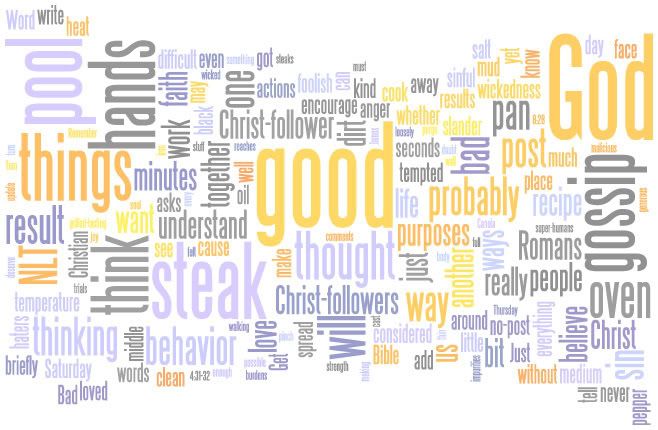
    I assume that it's pulling from the most recent posts, because when I plugged EGBDF into it, I came up with God, good, things, and steak being some of the most prominent words. Oh, and gossip, too. Have a look. This is so cool that I think I'm going to use it for my wallpaper!

    Thanks, Billy!

    21 July 2008

    Dirt in an Otherwise Clear Pool

    On Saturday I picked up a Nerf ball from a dirty area of the yard. As a result, my hands got some wet dirt (that'd be mud) on them, and I brushed my hands together to knock the loose stuff off.

    On my way back to the nearly-complete deck (about which I'll post an update at some point), I looked at my hands and saw that they still had some dirt and grass particles on them. Not much, but enough that I didn't want to wipe my hands on my pants. I was walking past the (above-ground) swimming pool and thought briefly about dipping my hands in the pool to rinse off the mud. I thought, "It's only a little bit of debris. With the volume of water in the pool it'll barely be noticed."

    Then I decided against it -- we make deliberate efforts to keep the pool as clean as it can be, and that would have introduced more matter into the pool for the pump and filter to ostensibly clean up. If the pool had been dirtier, I probably wouldn't have felt so bad about rinsing my hands in it (if it had been too filthy I'd probably have not even considered it, though).

    It struck me that Christ-followers seem to think of gossip or slander in the way I briefly thought of cleaning my hands in the pool.

    "It probably won't hurt to tell this person about what I heard. After all, they're a fellow Christian and they'll understand and won't spread it around. Better to tell a Christian than a non-Christian." Just a tiny bit of dirt in a large pool that's otherwise cleansed of impurities.

    I think that when it suits our purposes, we must think of other Christ-followers as super-humans. Do we really think that a little bit of gossip is okay? Do we think that spreading the "joy" of our otherwise-unknown tale or opinion is harmless? If we're tempted to spread something around, won't they be tempted, as well?

    I did not write the following, in which the word "gossip" appears right in the middle of a number of actions attributed to "haters of God." While it's just one behavior in this long list and you may not participate in the other things, it's obvious that gossip is not an acceptable action for the Christ-follower.

    "But God shows his anger from heaven against all sinful, wicked people who suppress the truth by their wickedness... Since they thought it foolish to acknowledge God, he abandoned them to their foolish thinking and let them do things that should never be done. Their lives became full of every kind of wickedness, sin, greed, hate, envy, murder, quarreling, deception, malicious behavior, and gossip. They are backstabbers, haters of God, insolent, proud, and boastful. They invent new ways of sinning, and they disobey their parents. They refuse to understand, break their promises, are heartless, and have no mercy. They know God’s justice requires that those who do these things deserve to die, yet they do them anyway. Worse yet, they encourage others to do them, too." (Romans 1:18, 28-32, NLT)

    Remember, I did not write that. Also understand that I'm not calling you a "God-hater" if you happen to have participated in gossip. I use that Scripture to encourage you to purge a particular behavior from your repertoire of behaviors.

    When in doubt as to whether or not your piece of information is gossip, it's best to err on the side of caution. Sometimes the choice is difficult -- really difficult. Continually ask God for discernment and wisdom, with faith; never doubting (James 1:5-8).

    "Get rid of all bitterness, rage, anger, harsh words, and slander, as well as all types of evil behavior. Instead, be kind to each other, tenderhearted, forgiving one another, just as God through Christ has forgiven you." (Ephesians 4:31-32, NLT)

    15 July 2008

    What Makes a Bad Word Bad?

    I'm curious as to whether or not the title today made you think of Disney's Peter Pan. It made me do so. When I thought of that particular phrase, I mentally sung the song "What Makes the Red Man Red," and those lyrics made me think of Disney and other cultural conspiracy theories, which might be fun to talk about at some point, and if I do I'll tell you why I thought of the conspiracy theory bit (for instance, remember how The Wonderful World of Disney used to come on TV on Sunday nights, when all good folks should have been at church? Conspiracy or just regular ol' programming?).

    How's that for getting diverted from the subject even before getting into it? Here we go, getting on track...

    Although I love words and using them, I'm not a linguist, so I've not researched this subject all that well. However, I think I have a decent answer to the question, "What makes a bad word bad?"

    "And so blessing and cursing come pouring out of the same mouth. Surely, my brothers and sisters, this is not right! Does a spring of water bubble out with both fresh water and bitter water? Does a fig tree produce olives, or a grapevine produce figs? No, and you can’t draw fresh water from a salty spring." (James 3:10-12, NLT)

    Obviously there are some things that a Christ-follower just should not be saying.

    Some of you may want to brace yourselves, because although what I'm about to say is not swearing, it's not something that you see in print every day. I remember hearing a preacher say something like this in a sermon when I was a teenager: "When you say one particular curse word about someone, you're actually asking God to damn that person," as in, asking God to send them to hell. So when a person is swearing at someone, we can directly see that it's a bad thing.

    When was the last time you read The Living Bible, by the way? I remember reading it as a kid and having my eyebrows go through the roof at a couple of passages.

    Not long ago my think-tank and I (that hopefully makes us all sound intelligent) were looking at the origin of one particular word and found that it had been used as slang pretty much since its inception hundreds of years ago in another country. Seems to have been invented just to be a bad word.

    But how about those words that we've grown up being taught that we shouldn't say -- those words that some kids mutter in hushed tones as a sort of rite of passage into teen-dom? The ones that are screamed at drivers who aren't as proficient, observant, and perfect as are we? (I'm not suggesting that I do this -- I'm just using "we" because it works better in the sentence, and I certainly can't accuse you of it.) Culturally these are regarded as "bad" words. Why?

    Without Googling (which I hereby declare to be cheating in this case), I'd like to ask you to comment on what you believe generally (or specifically) makes them "bad." In this case, broad, sweeping statements are okay. Let's pretend that there are no wrong answers. Keep your language clean. Heh... After posting your comment, click on the brain above and see what the scientific community seems to say about swearing over at www.HowStuffWorks.com. Very interesting stuff. I really thought it was a joke at first.

    19 June 2008

    Rolling? TPing? Papering?

    (One of our rare special interest stories here at EGBDF, Int'l...)

    Ah, isn't it nice to have friends? This sight greeted me this morning: Also added to my yard was the item seen in the new photo at my profile. The only reason I'm pretty sure that this was intended for me was the fact that "Ken" was written and marked out on the doll thing (seen at my profile page) and "Dean" was written in its place. Oh, and the facial hair was shaved a little like mine.

    I'm still immature enough to think that this really calls for retribution.

    Speaking of "rolling," "TPing," "papering," etc. (I call it "rolling"), here's a quiz you can take to see what sort of American English you probably speak. Based on the quiz, here's my linguistic profile:

    50% General American English
    30% Dixie
    15% Yankee
    0% Midwestern
    0% Upper Midwestern

    Twitter Delicious Facebook Digg Stumbleupon Favorites More

     
    Design by Free WordPress Themes | Bloggerized by Lasantha - Premium Blogger Themes | Bluehost Review